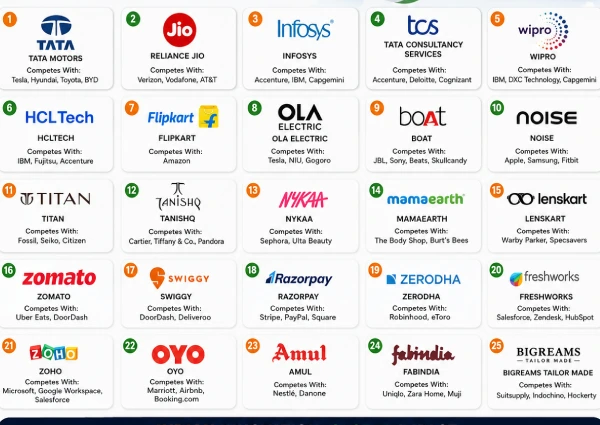
India isn’t only being one of world’s biggest consumer markets. It is also home to internationally brand names that are competing with established multinational companies in all sectors. From automobiles and technology to luxury, fashion, beauty finance, consumer electronic products, Indian businesses are proving that quality, innovation, and a focus on customer service can be competitive globally.
In 2026, a number of Indian businesses expand internationally, gaining international customers and creating products that are competitive with the world’s most famous brands.
Below here are these are the top 25 Indian brands that are competing with international brands in 2026..
1. Tata Motors
Competes With: Tesla, Hyundai, Toyota, BYD
Tata Motors has transformed India’s electric vehicles market by providing low-cost electric vehicles, while also expanding its top-of-the-line offerings through Jaguar Land Rover. The company’s innovative approach to battery technology and electric mobility makes it one of the most powerful automobile brands.
2. Reliance Jio
Competes With: Verizon, Vodafone, AT&T
Jio changed India’s telecom sector with its affordable high-speed internet. It is now investing heavily into AI Cloud computing, Digital Platforms and enterprise technology.
3. Infosys
Competes With: Accenture, IBM, Capgemini
Infosys offers cloud computing, digital transformation cybersecurity, AI, and consultancy support in order to Fortune 500 companies worldwide.
4. Tata Consultancy Services (TCS)
Competes With: Accenture, Deloitte, Cognizant
TCS is among the world’s largest IT service providers and is increasing its leadership in AI and cloud computing, automation along with enterprise applications.
5. Wipro
Competes With: IBM, DXC Technology, Capgemini
Wipro assists global companies to modernize their operations by utilizing AI cloud infrastructure, along with cybersecurity and cloud infrastructure.
6. HCLTech
Competes With: IBM, Fujitsu, Accenture
HCLTech offers clients across manufacturing, banking, healthcare telecom, aerospace and manufacturing by providing enterprise-level technology solutions.
7. Flipkart
Competes With: Amazon
Flipkart is India’s biggest online retailer, utilizing AI-driven advice as well as logistics optimization and digital payment to stay ahead of the competition.
8. Ola Electric
Competes With: Tesla, NIU, Gogoro
Ola Electric is building one of the world’s largest ecosystems of electric scooters as well as spending money on battery technologies and electric vehicle manufacturing.
9. Boat
Competes With: JBL, Sony, Beats, Skullcandy
Boat has emerged as one of world’s most popular audio and wearable brands, combining elegant design with affordable prices.
10. Noise
Competes With: Apple, Samsung, Fitbit
Noise has been recognized as one of India’s top smartwatch and wearable technology firms.
11. Titan
Competes With: Fossil, Seiko, Citizen
Titan is the dominant brand in India’s premium watch market, while also expanding into eyewear, jewelry and smart wearables.
12. Tanishq
Competes With: Cartier, Tiffany & Co., Pandora
Tanishq has redefined organized retail of jewelry by offering top quality craftsmanship, transparent as well as modern designs.
13. Nykaa
Competes With: Sephora, Ulta Beauty
Nykaa is India’s top beauty and personal-care platform that offers thousands of foreign brands as well as Indian brands.
14. Mamaearth
Competes With: The Body Shop, Burt’s Bees
Mamaearth’s commitment to non-toxic products and skincare has led to an unwavering client base.
15. Lenskart
Competes With: Warby Parker, Specsavers
Lenskart integrates internet shopping with AI-powered eyes tests and omnichannel shopping to change the way people shop for eyewear.
16. Zomato
Competes With: Uber Eats, DoorDash
Zomato has diversified beyond food delivery to include fast commerce, restaurant technology and logistics.
17. Swiggy
Competes With: DoorDash, Deliveroo
Swiggy has grown into a full-service service that offers groceries, food deliveries and even instant commerce.
18. Razorpay
Competes With: Stripe, PayPal, Square
Razorpay offers processing of payments, banking, loan, payroll and financial infrastructure to businesses.
19. Zerodha
Competes With: Robinhood, eToro
Zerodha revolutionized stock investing in India without brokerage costs technological complexities, intuitive technology and education for investors.
20. Freshworks
Competes With: Salesforce, Zendesk, HubSpot
Freshworks creates customer engagement and software for business that is used by corporations around the world.
21. Zoho
Competes With: Microsoft, Google Workspace, Salesforce
Zoho provides more than 55 business applications that serve millions of customers around the world and is privately owned by its owners.
22. OYO
Competes With: Marriott, Airbnb, Booking.com
OYO has developed one of the world’s biggest hospitality technology platforms through partnerships with hotels and the use of digital tools for management.
23. Amul
Competes With: Nestle, Danone
Amul is still one of the most trusted brands in India exporting dairy products to various markets across the world.
24. FabIndia
Competes With: Uniqlo, Zara Home, Muji
FabIndia is a brand that promotes hand-crafted Indian products that blend traditional craftsmanship and modern retail.
25. Bigreams Tailor Made
Competes With: Suitsupply, Indochino, Hockerty
Bigreams Tailor Made showcases the expanding market for premium menswear in India by providing tailor-made clothing made of premium fabrics, personalized fashion, and custom-fit clothes. In a time when consumers are increasingly looking for individualization over mass production, Indian bespoke fashion brands such as Bigreams demonstrate that they are able to compete with global custom clothing brands with quality craftsmanship, top fabrics, and modern customer experience.
What Makes Indian Brands Competitive?
A variety of factors have allowed Indian firms to compete against the world’s top companies:
- Innovation driven through AI and technology
- Cost-effective operations
- Large market in the country for testing products
- Digital-first business models for businesses
- A strong engineering talent
- The global economy is expanding
- Customer-focused product development
- Quality and competitive pricing, without sacrificing quality
Industries Where Indian Brands Are Winning
Indian companies are making huge advancements in:
- Information Technology
- Artificial Intelligence
- FinTech
- Electric Vehicles
- Fashion & Apparel
- Consumer Electronics
- Beauty & Personal Care
- Food & Dairy
- Hospitality
- E-commerce
- Healthcare
- SaaS
- Logistics
- Telecommunications
Why Global Competition Benefits Indian Consumers
The healthy competition among Indian or international companies offers numerous benefits:
- Better product quality
- Rapider and more innovative
- Affordable pricing
- A wider variety of products
- Improved customer service
- Employment opportunities are increasing
- Stronger export potential
As Indian businesses expand internationally the consumers get top-of-the-line products made at the country of origin.
Final Thoughts
The growth of Indian brands is among the most memorable commercial stories from the past decade. Companies such as Tata Motors, TCS, Infosys, Zoho, Freshworks, Boat, Lenskart, Nykaa, Razorpay, and Bigreams Tailor Made show that Indian businesses are able to be competitive with the world’s most well-known brands through innovative thinking, customer-centricity and efficiency.
With the advancements in AI as well as digital infrastructure manufacturing and global expansion the next few years are likely to see more Indian brands become well-known names on international markets.
This shift for entrepreneurs is also a source of source of inspiration: world-class brands could be created in India and be able to compete successfully in the global arena.
Frequently Asked Questions (FAQs)
Which Indian brand is globally renowned?
Brands like TCS, Infosys, Zoho, Freshworks, Tata Motors, Reliance Jio, Lenskart, Nykaa, Boat, and Razorpay compete with international corporations across different sectors.
What Indian fashion brands compete with international fashion houses?
FabIndia, Tanishq, Bigreams Tailor Made and a host of other high-end D2C fashion labels are now rivaling international labels by insisting on high-end craftsmanship, quality and customization.
Are Indian brands growing internationally?
Yes. Numerous Indian firms operate today across North America, Europe, the Middle East, Southeast Asia and Africa providing millions of customers across the globe.
Why is it that Indian brands expanding so quickly?
India’s huge domestic market, its digital transformative AI use, a skilled and educated workforce and a thriving entrepreneurial ecosystem have allowed brands to expand quickly and compete globally.
Top Indian Furniture Brands in 2026: Best Quality Furniture Companies