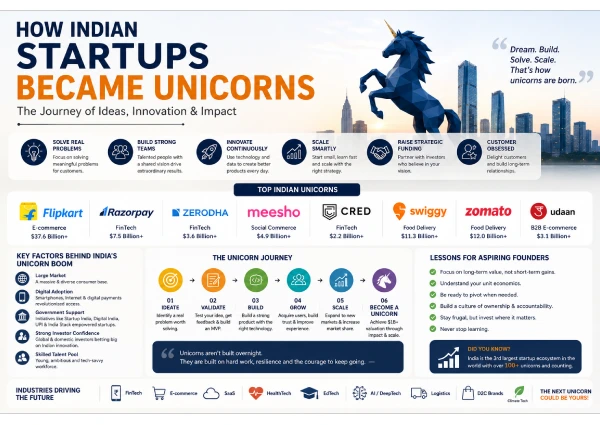
India has grown into one of the fastest growing startups’ communities. What started as an uninvolved group of entrepreneurs who were launching technology-related businesses has grown into an impressive commercial model which has produced more than 100 unicorn companies.
Companies such as Flipkart, Razorpay, Zerodha, CRED, Meesho, Swiggy, Zomato, and many others have revolutionized entire industries and have created billions of dollars in worth of value.
It’s not only about getting a huge round of capital. Behind every billion-dollar enterprise is years of problem-solving, fascination with customers, calculated risk, and constant execution.
The article, we’ll explore the methods Indian startups became unicorns, the common strategies they adopted and the lessons entrepreneurs can learn from their experiences.
What Is a Unicorn Startup?
The phrase “unicorn” refers to unicorns. It is a privately held startup company with a valuation of over 1 billion dollars..
It was initially used by venture capitalist Aileen Lee in 2013 because of the fact that companies which had been valued to this price were previously believed to be rare, akin to unicorns of myth.
At present, India is home to one of the largest unicorn ecosystems around the globe. that includes industries such as finance fintech and ecommerce as well as SaaS and healthcare technology, in addition to logistics AI, edtech, Direct-to-Consumer (D2C) companies.
The Rise of India’s Startup Ecosystem
In the past decade most Indian entrepreneurs focused their efforts on companies that offered solutions. In time the availability of internet technology improved, and cheap smartphones as well as digital payment and the favourable policies of the government created a favorable environment where technology startups could grow rapidly.
Many factors influenced this transformation:
- Access to a reasonable internet
- Widespread smartphone adoption
- Digital payment infrastructure
- The middle class are increasing
- More venture capital investment
- Government initiatives to assist entrepreneurs
- A large database of experienced engineers and developers.
This technology has enabled entrepreneurs to tackle issues of a large scale with millions of clients.
Characteristics Shared by Successful Unicorn Startups
Although every startup has its own path however, many Indian unicorns share an underlying thread.
1. Solving Real Problems
Every business that succeeds starts by addressing the real problem.
Examples include:
- Online shopping convenience
- Digital payment
- Food delivery
- Investment in stocks
- Online education
- Healthcare access
- Logistics management
Instead of creating products first, then seeking buyers later The unicorn founders were focused on solving problems common to all people.
2. Starting Small and Scaling Gradually
Most unicorns didn’t launch nationwide overnight.
The majority of them started in one place or targeted an individual customer segment before expanding.
Examples include:
- Food delivery in one city
- Online clothing falls in one category
- Digital payment for small-scale merchants
- Platforms to invest for investors who are not experienced
Following the time they verified their business model They expanded their business across India.
3. Technology as the Core Business
Technology was more than an instrument. It was the foundation of their business.
Innovative startups have poured an enormous amount of money:
- Mobile applications
- Artificial Intelligence
- Automation
- Cloud computing
- Data analytics
- Machine learning
- Customization for the user
Technology has allowed them to serve millions of customers easily.
The Importance of Customer Experience
One of the main reasons Indian companies were able to be unicorns was their relentless focus on the satisfaction of their customers.
Startups that are most profitable will have a focus:
- Simple-to-use applications
- Fast customer support
- Transparent pricing
- Reliable delivery
- Simple user interfaces
- User experiences are customized
Customers who were happy not only stayed on, but also referred the site to family and friends and this is an organic expansion.
The Role of Venture Capital
A business’s growth often requires significant capital.
Indian unicorns have attracted money from investors from both across the United States and around the world, believing that they have the potential to be successful in the long-term.
Startups could profit from financing the chance to finance:
- Talented teams to hire
- Technology development
- Marketing
- Innovation in product design
- Geographic expansion
- Acquiring customers
But, just funding doesn’t make an unicorn. Investors typically invest in companies that have good execution and have a clear direction to expand.
Government Support
The initiatives of the government have played a major part in helping to build the startup community across India.
Programs like:
- Startup India
- Digital India
- UPI ecosystem
- India Stack
- A faster company registration
- Tax incentive for those who start businesses that are eligible
It is now easy for entrepreneurs to start and expand their business.
The digital public infrastructure cut down on barriers for businesses in the field that include fintech, online commerce, and tech companies.
Building Strong Teams
The key to every success startup is a team that performs well.
Unicorn the founders of HTML0 are determined to attract those who share their goals and can cooperate on challenging issues.
Entrepreneurs who have been successful, invest in:
- Leadership development
- The ownership of employee
- Always learning
- The work environment encourages collaboration
- Innovation
The employees who work for startups often are the company’s greatest benefit to its competitive edge.
Learning from failure
Many unicorns have faced difficulties before they achieved success they have achieved.
The challenges were:
- Product failures
- Funding difficulties
- Hiring mistakes
- Operational problems
- Regulation changes
- Strong competition
Instead of being unsuccessful founders who were successful quickly learn, changed their strategies and developed the strategies they employed in their businesses.
Case Studies of Indian Unicorns
Flipkart
in 2007 Flipkart revolutionized the online shopping experience in India by ensuring the trust of customers, effectiveness, speedy delivery, and a wide variety of items. Innovations like cash-on delivery have made it simpler for new online shoppers to get started.
Key Lesson
Find out about local habits of your customers and adapt your model of business to accommodate local requirements.
Razorpay
Razorpay created digital payment more convenient for businesses, by offering an easy way to integrate payment gateways with the financial service.
Key Lesson
Business problems that are difficult to solve can be resolved with basic technology.
Zerodha
Contrary to other startups that heavily rely on capital from venture capital, Zerodha achieved remarkable growth because of its incredibly well-designed and customer-focused approach. With its low-cost trading solutions and simple platform, it attracted hundreds of potential investors.
Key Lesson
Sustainability and growth are just as effective as rapid fundraising.
Meesho
Meesho enabled companies of all sizes to sell their products online through social commerce, which gives entrepreneurs across India.
Key Lesson
Provide opportunities to other users to assist customers in resolving their problems.
CRED
CRED created a premium platform which gives responsible cardholders exclusive benefits. This creates an exclusive offer of value.
Key Lesson
Differentiation is crucial. A niche-specific solution can yield substantial growth.
Innovation Drives Growth
Most successful companies continue to evolve.
They:
- Introduce new features
- Enhance customer experience
- Experiment with pricing
- Extend the range of products
- Utilize the newest technology
Innovation isn’t a once-in-a-lifetime occasion. It’s a continuous process.
Data-Driven Decision Making
Modern businesses heavily rely upon information to understand the behavior of their customers and improve their business.
Most important are the following metrics:
- Customer acquisition Cost (CAC)
- “Value of life” (LTV)
- Rate of Retention
- Conversion rate
- Churn rate
- Growth in revenue
Startups that are driven by data can make informed choices instead of being based on intuition.
Common Challenges Faced by Indian Unicorns
The road to becoming a unicorns isn’t always simple.
Common issues are found in:
- Intense competition on the market
- The control of rapid expansion
- Highly skilled and knowledgeable in the area of hiring
- Regulation compliance
- The pressure on profit
- Customer retention
- The complexity of the supply chain
- The company’s culture must be maintained
Entrepreneurs who succeed recognize these challenges as opportunities to expand their business.
Lessons for Aspiring Entrepreneurs
If you’re considering making your own unicorn, be sure to consider these guidelines:
- Solve real-world problems.
- Learn to comprehend the needs of your clients.
- Make a service users truly love.
- Be focused on the long-term advantages over the short-term gains.
- Find extraordinary employees.
- Join the technology revolution and in the field of innovation.
- Learn from your mistakes.
- Scale responsibly.
- Maintain financial discipline.
- Make sure you are determined to achieve the goals you have set for yourself.
A billion-dollar company requires time patience determination, persistence and flexibility.
The Future of India’s Startup Ecosystem
Startup ecosystem in India is rapidly growing.
The sectors that are emerging with the potential to grow include:
- Artificial Intelligence (AI)
- SaaS
- Climate technology
- Electric mobility
- Healthtech
- Agritech
- Robotics
- Space technology
- Deeptech
- Technology to facilitate the financial transaction (FinTech)
With digitalization growing and the speed of innovation is increasing, India is expected to be a major source for international startups.
Frequently Asked Questions
What exactly is an unicorn start-up?
A unicorn company is privately owned and operated business worth more than one billion dollars.
What’s the reason behind India is creating many more unicorns?
Factors like the growth of digital technology as well as the huge market for consumers and an increase in investment in skilled workers and initiatives funded by the government have resulted in the rise of unicorn companies.
Are all unicorns profitable?
It’s not true. Certain unicorns earn money quickly and some unicorns place a greater emphasis on the growth of their business over profits prior to making profits. There are different business strategies employed across different sectors.
Could a tiny start-up become an unicorn?
Absolutely. Many unicorns began with small teams working on particular customer problems. An efficient implementation and flexible solutions enabled them to expand.
What industries are more unicorn-friendly?
FinTech E-commerce FinTech SaaS, healthtech logistics AI, edtech, and D2C brands have led to the creation of several unicorn startups in India.
Final Thoughts
The rise in Indian unicorn-driven startups is an indication of the country’s rising entrepreneurial spirit and technological advances driving the growth of the economics of the digital. While billion-dollar valuations get the attention of the media however the heart of every unicorn is solving real issues, generating incredible products and delivering the best value to its customers.
Entrepreneurs looking to start the possibility of starting a business should bear at heart that creation of a unicorn isn’t the primary objective. Building a long-lasting company that is appreciated by customers is. It is important to know your customers, and be creative and forming teams, and able to respond to new opportunities. Financial success in the sector is typically due to providing long-lasting value.
The ecosystem of startups in India is growing and there are new opportunities in AI and healthcare technology, climate change and SaaS, aswell deeptech, the next wave of unicorns may already be beginning to take form.
Indian Startups That Became Unicorns: Billion-Dollar Success Stories