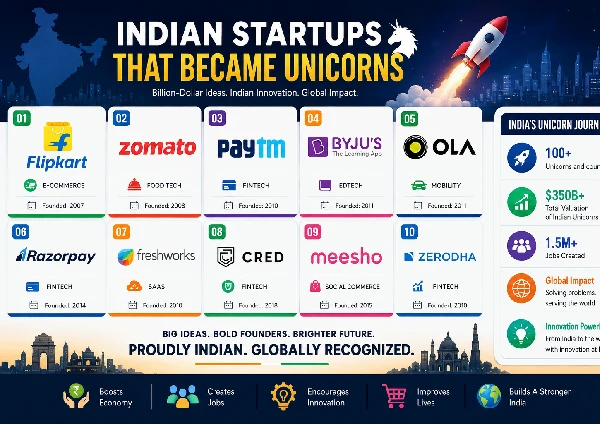
India is currently an exciting startup places. Over the decade that has passed, it witnessed an entrepreneurial revolution driven by the digital revolution, wide-spread internet access, increasing venture capital investments, as well as the thriving spirit of ingenuity.
The most reliable proofs for this can be seen in the growth the number of startups that resemble unicorns. The term “unicorn” refers to a privately-owned company valued at over 1 billion USD. Though they were previously thought as rare, the unicorn is now becoming more common in India’s expanding startup sector.
From fintech to ecommerce all the way to SaaS and educational technologies, Indian startups are solving complicated problems, generating jobs, attracting foreign investments and evolving industries.
We’ll take a look at those that have been the best-performing Indian unicorn-based startups, their path to success, and the lessons entrepreneurs could learn from their experiences.
What Is a Unicorn Startup?
“Unicorn” is a term invented by “unicorn” was coined by venture capitalist Aileen Lee in 2013 to describe startups valued at more than $1 billion.
Unicorns are significant since they symbolize:
- Incredible growth potential
- Strong market demand
- Market confidence
- Business models that scale for companies
- Industrial disruption
India is currently one of the leading nations in the creation of unicorns.
The Rise of India’s Startup Ecosystem
Many factors have contributed to the flourishing startups in India:
Growing Internet Penetration
The ability to access the internet and smartphones for a reasonable cost have created one of the biggest user bases for digital technology.
Venture Capital Funding
The global investors have been increasingly focused on India as a possible expansion market.
Government Support
Programs such as Startup India and Digital India have helped entrepreneurs.
Young Population
A young Indian workforce has a lot of potential to grow and develop.
This has created an a perfect environment for startups to flourish.
1. Flipkart
It was founded at the end of 2007 Flipkart is often regarded as the pioneer of India’s current online retail market.
Founders
- Sachin Bansal
- Binny Bansal
Industry
E-commerce
Why It Succeeded
- Innovative technology that’s focused on the user
- The cash-on delivery model
- A strong logistical infrastructure
- Aggressive expansion
Its success with Flipkart set the stage for numerous other Indian start-up companies.
2. Zomato
What started as a website for finding restaurants became India’s largest food delivery service.
Industry
Food Technology
Key Success Factors
- Brand recognition is high.
- Platform which is friendly for users
- Rapid market expansion
- Strategic acquisitions
At present Zomato has millions of customers across multiple markets.
3. Paytm
Paytm was a major element to the explosive growth in digital payment across India.
Industry
Fintech
Growth Drivers
- Mobile wallets, mobile phones and other wallets have become an increasingly popular option
- Payments via QR code
- Financial services expansion
- A robust merchant network that includes merchants
It was one of the major players in India’s market for cashless transactions.
4. Byju’s
Byju’s technology revolutionized online education in India using technology to enhance education.
Industry
EdTech
Why It Grew Rapidly
- Interactive learning content
- marketing that’s effective
- Spread across the country
- Digital-first strategy
The company was one of the most well-known educational institutions within India.
5. Ola
Ola changed the way people move around cities by linking people to drivers via a mobile app.
Industry
Mobility
Key Strengths
- Wide geographic coverage
- Localized services
- Numerous transport options
- Competitive pricing
Ola is among the most well-known Indian start-up companies in the field of mobile.
6. Razorpay
Razorpay is making it simpler to accept digital payments for any business.
Industry
Fintech
Reasons for Success
- Integration of payments is easy and simple
- Solutions for companies that are flexible for business
- A solid technology infrastructure
- Continuous innovation in product development
It has become an important player in the Indian fintech industry.
7. Freshworks
Freshworks has been able to achieve international recognition for its customer interaction and the most recent business-related solutions.
Industry
SaaS
Competitive Advantages
- Enterprise software for reasonable cost
- Global customer base
- Strong product design
- Scalable business model
Freshworks demonstrated that Indian SaaS companies are able to compete internationally.
8. CRED
CRED has created an original business model based upon the idea of rewarding responsible use of credit cards.
Industry
Fintech
Success Factors
- Premium customer focus
- Innovative rewards system
- Branding and positioning to create a solid brand
- Rapid user growth
The company soon reached the status of an unicorn.
9. Meesho
Meesho aids small-sized companies and individuals market their products on the internet.
Industry
Social Commerce
Why It Stands Out
- Reseller-driven model
- Mobile-first platform
- A significant presence in cities that have smaller populations.
- Affordable entrepreneurship opportunities
Meesho has expanded its online shopping services to India.
10. Zerodha
Zerodha transformed investing with the introduction of cheapest brokering services.
Industry
Fintech
Growth Drivers
- Transparent pricing
- platform that’s friendly for users
- Education for investors
- Operation powered by technology
At present, Zerodha is one of the biggest Indian stockbroking firms.
What Makes Indian Unicorns Successful?
Although they are in various sectors, the majority of Indian unicorns share common characteristics.
Solving Real Problems
Successful startups focus on the actual customer problems.
Technology Adoption
Digital platforms enable rapid scaling and boost efficiency.
Scalability
Most successful companies create businesses that expand globally and nationally.
Customer-Centric Approach
Understanding the needs of the user is the most important factor to the success of.
Strong Leadership
Creative founders who are visionary typically those who are driving the development of ideas, and also increase their efficiency.
Challenges Faced by Unicorn Startups
The quest to become a unicorn is just the beginning of the fun.
Many startup companies have to confront issues such as:
Intense Competition
Markets are becoming more crowded as companies mature.
Regulatory Changes
Companies must be able to adapt to changing policies and regulations.
Profitability Pressures
Investors are seeking constant growth.
Talent Acquisition
Retention and the hiring of qualified workers can be a major challenge.
It is essential to conquer these obstacles is vital to ensure the long-term viability of your business.
The Economic Impact of Unicorn Startups
Indian unicorns can have significant economic impact through:
Job Creation
Many thousands indirect and direct job openings.
Investment Attraction
Global investors put capital into the Indian economy.
Innovation
The introduction of new technologies and solutions can help improve customer experience.
Digital Transformation
The use of technology is increasing across all industries.
Global Recognition
A thriving business model for successful startups has contributed to make India an incubator hub for innovation.
Lessons Entrepreneurs Can Learn
Popularity of Indian unicorns can teach useful lessons.
Focus on Customer Problems
Most successful companies address real-world issues.
Think Long-Term
A successful startup requires patience and persistence.
Embrace Innovation
Continuous improvement is essential in competitive markets.
Build Strong Teams
People are one of the most valuable assets for startups.
Stay Adaptable
The market’s conditions may change quickly.
Flexibleness is frequently the determining factor for the long term success of HTML0.
The Future of Indian Unicorns
India’s startup ecosystem continues develop quickly.
The new industries that could make the next unicorn are:
- Artificial Intelligence
- Climate Technology
- Healthcare Technology
- Deep Technology
- SaaS
- Electric Mobility
- Fintech
- Cybersecurity
As the usage of the internet increases and financial markets mature, India is expected to make a lot more unicorn companies in the next couple of years.
Final Thoughts
The increasing popularity of Indian unicorn companies is an indication of the remarkable transformation that has been taking place in the entrepreneurship landscape of India. Companies such as Flipkart, Paytm, Zomato, Razorpay, Freshworks, Zerodha and Meesho have demonstrated that companies with the best quality can be built in India and compete globally.
Their success stories will inspire the next generation of entrepreneurs and are a significant contributor to economic growth, innovation in addition to the growth of new jobs.
The Indian startups are beginning to mature and growing, India is set to become one of the top centers of entrepreneurship and technology all over the world. The next unicorn may be being developed in a dorm room at a college or in a tiny office or in an incubator for startups located in India.