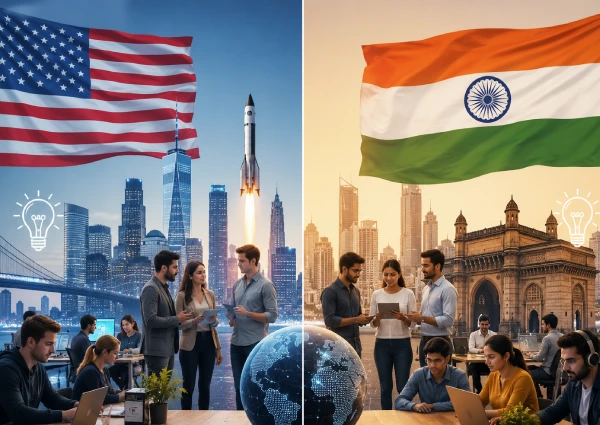
The rise of startups has changed economies across the globe and created numerous new sectors, employment and new ideas. Although there is no doubt that the United States remains the global top entrepreneur and in venture capital India is now one of the fastest growing ecosystems for startups around the globe.
Both countries are creating unicorns, drawing investors, and fostering innovation at unimaginable levels. But their startup ecosystems differ greatly in terms of the availability of capital, market dynamics access to talent, regulatory frameworks in addition to growth possibilities.
This article focuses on the major features and differences between the startups ecosystems in the United States and India, aiding entrepreneurs to understand the areas where each one excels as well as what future could be in store for them.
Understanding Startup Ecosystems
A startup ecosystem is the community of investors, entrepreneurs incubators, accelerators, corporations, universities policies of the government, as well as support and services to allow startups to expand and grow.
A healthy ecosystem usually offers:
- Capital access
- Talented, skilled
- Mentorship
- Business-friendly rules
- Market opportunities
- Innovation culture
The United States and India have established vibrant startup ecosystems however, they’ve developed with distinct social and economic circumstances.
The Evolution of the US Startup Ecosystem
The United States has long been believed to be the home of modern-day entrepreneurialism.
The development of Silicon Valley in California during the second quarter of the 20th century created a culture that promoted risk-taking, innovation and venture capital investments.
Companies like Apple, Microsoft, Google, Amazon, Facebook, Tesla and Airbnb were born within the US startups and later were able to become global players.
Key Characteristics of the US Ecosystem
- Mature venture capital network
- A strong culture of innovation
- Deep technology expertise
- World-class universities
- Large angel investor community
- Access to the global market
- Access to high-startup funding
The US is still the standard against which all other ecosystems for startups are evaluated.
The Rise of India’s Startup Ecosystem
The pace of India’s startups accelerated following the widespread use of smartphones and the internet.
In the last 10 years initiatives such as Digital India, Startup India and increased venture capital investment have transformed India into a global startup hub.
Presently, India is home to hundreds of startups in Fintech, SaaS, healthtech, ecommerce, edtech logistics, AI and even deep technology.
Key Characteristics of the Indian Ecosystem
- Massive consumer market
- Operation cost-effective
- Young workforce
- Rapid digital adoption
- A growing interest from investors
- Startup initiatives funded by the government
- Global recognition is growing
India has grown into one of the largest startups and continues to draw both local as well as foreign investors.
Market Size: US vs India
United States
The US provides one of the world’s biggest consumers with a high-spending budget.
Customers usually have more purchasing power, which makes it easier for entrepreneurs to earn more revenue per customer.
Benefits include:
- A higher average of customer spending
- A strong B2B market
- Opportunities for Enterprise Software
- Global reach of customers
India
The Indian market is driven by size, not spending power.
While the average cost per user could be lower Startups can reach thousands of million potential customers.
Benefits include:
- Huge population
- Rapid smartphone penetration
- The middle class is growing
- Expanding digital economy
Winner: Depends on Business Model
Premium products typically perform better in the US as well as high-volume companies that can scale are successful in India.
Funding Environment
Access to financing is among the biggest distinctions between the two ecosystems.
United States
The US is home to the world’s most sophisticated venture capital market.
Startups are often able to access:
- Angel investors
- Seed money
- Venture capital firms
- Private equity
- Corporate investors
- Markets for public goods
Many start-ups raise millions of dollars, even before they generate significant revenues.
India
The ecosystem of Indian finance has grown quickly, but it is still smaller than the US.
Sources of funding include:
- Angel networks
- Venture capital firms
- Family offices
- Corporate investors
- International money
Although the number of funding options is growing however, the competition for capital is high.
Winner: United States
In the US continues to provide better accessibility to funding for startups at all phases.
Talent Availability
United States
The US is a magnet for top talent all over the world.
Strengths include:
- Top universities
- Advanced research institutions
- Expertise in technical aspects
- Professionals with experience in startup
However, the costs for hiring are much more expensive.
India
India produces thousands of graduates each year especially in technology and engineering fields.
Benefits include:
- A large talent pool
- Strong engineering skills in software
- Competitive labor costs
- Experience gained from a growing startup
Winner: India for Cost Efficiency, US for Specialized Expertise
Both ecosystems offer unique talent advantages.
Cost of Building a Startup
United States
Initial costs can be huge.
Costs of major expenses include:
- Salary of employees
- Office space
- Legal services
- Healthcare benefits
- Marketing costs
India
India has substantially lower operating cost.
Benefits include:
- Affordable talent
- Lower infrastructure expenses
- Cost-effective software development
- Costs of administration reduced
Winner: India
Entrepreneurs often have the ability to create and scale their startups at a fraction of costs compared to the US.
Innovation and Research
United States
The US continues to be a global leader in:
- Artificial Intelligence
- Biotechnology
- Robotics
- Space technology
- Advanced manufacturing
Collaboration between industry and universities fuels the process of innovation.
India
India is rapidly becoming an innovation hub, especially in:
- Fintech
- SaaS
- Digital payment
- Ecommerce
- Healthtech
But, deep-tech innovation remains behind the US.
Winner: United States
The US is the leader in technological breakthroughs innovations and research commercialization.
Government Support
United States
The government encourages entrepreneurship by:
- Research grants
- Tax incentives
- Small-business programs for small businesses
- Innovation funding
However, regulations can differ substantially between states.
India
The government’s policies have significantly increased entrepreneurial activity.
The programs comprise:
- Startup India
- Digital India
- Make in India
- Fund of Funds for Startups
These programs have increased awareness of the startup process and provide assistance.
Winner: Draw
Both countries provide valuable support mechanisms, but their strategies differ.
Startup Success Stories
United States
Examples of notable startup success stories are:
- Amazon
- Airbnb
- Uber
- Stripe
- SpaceX
They transformed entire industries.
India
The Indian startup stories of success include:
- Flipkart
- Zerodha
- Freshworks
- Zomato
- Razorpay
- Ola
These companies are a sign of the growing the maturity of India’s economy.
Challenges Faced by Startups
Challenges in the US
- Operating costs that are too high
- Talent competition
- The complexity of regulation
- Market saturation
Challenges in India
- Infrastructure limitations
- Funding gaps at later stages
- Consumers who are price sensitive
- Regulative uncertainty in some industries
Both ecosystems present unique obstacles for founders.
Unicorn Creation
The term “unicorn” refers to a business that is valued at more than a billion dollars.
United States
The US continues to be the leader in the creation of unicorns due to its thriving infrastructure for funding and its innovation culture.
India
India has seen significant growth in the number of unicorns it has produced in recent years, and has become one of the top unicorn-producing nations in the world.
Winner: United States
But, India is narrowing the gap.
Global Expansion Opportunities
United States
US startups tend to expand internationally following the establishment of dominance in the US.
India
Many Indian startups are increasingly embracing the global first approach, particularly in the SaaS and the technology sector.
This trend has helped Indian startup companies to participate in the international arena.
Future Outlook
Future of the US Startup Ecosystem
The US is predicted to remain the world’s innovator due to:
- Advanced capabilities for research
- Strength of Venture Capital
- Global talent attraction
- Technology leadership
Future of the Indian Startup Ecosystem
India’s startup ecosystem is set to grow exponentially due to:
- Digital transformation
- Access to the internet is growing
- Young population
- Rising entrepreneurial culture
- A growing confidence in investors
Many analysts believe that India could be one of the most influential startups over the next decade.
Final Thoughts
The ecosystems for startups in both the United States and India are not competing, rather they complement each other as innovation engines.
It is true that the US excels in research, funding, and leadership in global innovation and India excels in scalability the efficiency of costs, adoption of digital technology and growth in entrepreneurship.
For investors, founders, as well as business executives, knowing these distinctions is vital when it comes to deciding where to invest, build, or expand.
With technology continuing to bring connectivity markets across the globe and markets, the future might not be about deciding between the US or India but instead leveraging each of the advantages offered by both economies to build the next generation of companies that will transform the world.