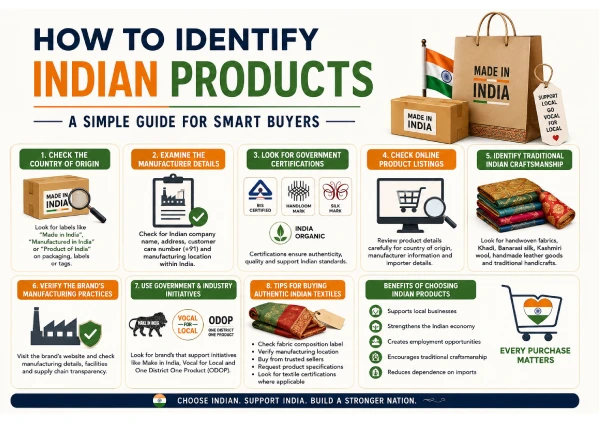
How To Identify Indian Products: A Simple Guide for Smart Buyers
Today’s consumers have more options that ever. With the increasing number of products exported and imported around the world, it can sometimes be difficult to pinpoint the place where a product was manufactured. If you are interested in helping local businesses, supporting Indian manufacturing, or making sure of the authenticity of your product, knowing how to recognize Indian products is a crucial capability.
This guide provides the most straightforward methods to identify products that are made by hand in India.
Why Buy Indian Products?
The choice of Indian-made products has many advantages:
- Helps local artisans and manufacturers
- The strengthening of the Indian economy
- Offers job opportunities
- Supports traditional craftsmanship
- Sometimes provides better after-sales service
- Reduces dependence on imported goods
If you’re shopping for clothing electronic equipment, home products or textiles, the support for Indian products helps in the development of our domestic industries.
Check the “Country of Origin”
The most straightforward way to determine the origin of an Indian merchandise is to search to”Country of Origin” or “Country of Origin” label.
Indian laws require a lot of products that are sold by India to clearly state the place of manufacture on their packaging.
Find phrases like:
- Made in India
- Manufactured in India
- Product of India
These marks are typically located on:
- Labels for products
- Packaging boxes
- Tags
- Product descriptions on e-commerce websites
Examine the Manufacturer Details
The most authentic Indian products have the name of the manufacturer.
Verify:
- Indian company name
- Indian address
- Customer support phone numbers that include Indian Country code (+91)
- Location of manufacturing within India
For instance:
Manufacturer:XYZ Textiles Pvt. Ltd.
Surat, Gujarat, India
This is a clear indication that the product is made in India.
Look for Government Certifications
Certain Indian products are certified by the Indian government as well as quality certifications.
Some common examples include:
BIS Certification
The Bureau of Indian Standards (BIS) certifies products that comply with Indian quality standards.
Handloom Mark
This is a genuine Indian handloom items.
Silk Mark
Verifies authenticity of Indian Silk products.
India Organic
Organic products are certified organic if they conform the Indian standards.
These certifications verify authenticity and the quality.
Check Online Product Listings
If you are shopping online, make sure to read the details of the product attentively.
Major marketplaces are now showing:
- Country of origin
- Information about the manufacturer
- Importer details
Before you purchase, read the specifications to confirm the item’s source.
Identify Traditional Indian Craftsmanship
Many Indian products are distinctive in their features that are a reflection of the local craftsmanship.
Examples include:
- Handwoven textiles
- Khadi textiles
- Banarasi silk
- Kashmiri wool products
- Leather goods made by hand
- Traditional handicrafts
They often highlight techniques passed down over generations.
Verify the Brand’s Manufacturing Practices
Certain Indian companies design their products locally, but make them overseas.
Visit the site of the brand’s owner and verify:
- Information on manufacturing
- Company’s history
- Production facilities
- Details of the supply chain
A company that is transparent will generally give information about the place where its products are produced.
Use Government and Industry Initiatives
Programmes that include:
- Make in India
- Vocal for Local
- One District One Product (ODOP)
Help consumers recognize and purchase the Indian-made products.
A lot of brands are proud to display their involvement in these programs.
Tips for Buying Authentic Indian Textiles
When you are buying fabrics and clothes:
- Examine the label of composition on the fabric.
- Check the location of manufacturing
- Shop from reputable sellers
- Request specifications for the product
- Check for textile certifications if they are applicable.
High-end Indian textiles are known worldwide for their workmanship, durability and rich heritage.
Conclusion
Finding Indian products is now easier than ever before if it is clear what you are looking for. By examining the manufacturing country, the manufacturer’s information such as certifications, the product description, you can make a well-informed purchase decision and also support Indian companies.
Every purchase is important. Making purchases from Indian manufacturers helps to strengthen local industries, safeguard the traditional craft and aid in the economic growth of India.