Introduction
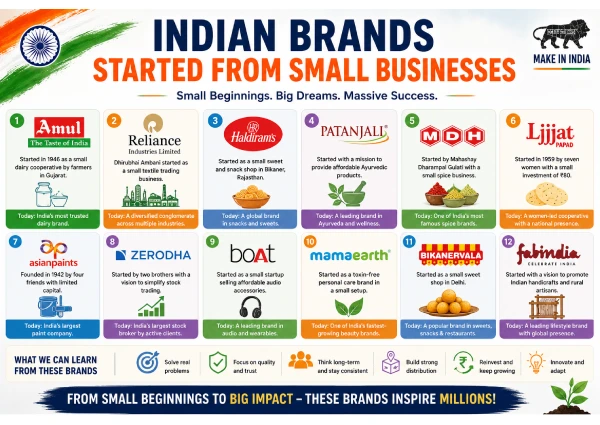
Every successful business begins with a start. Many begin with huge investments and large teams while others start out in a tiny room or garage, a family workshop, or one store. India is home to many successful business stories that show how entrepreneurs turned small businesses into household name brands.
These brands demonstrate that determination, vision along with innovation and customer trust can turn small beginnings into billion-dollar companies. Today, a lot of India’s top-rated enterprises started out as small-scale businesses with a limited budget but huge goals.
This article will look at a few of the best inspirational Indian companies that began small but eventually become the leaders in their field.
Why Small Businesses Matter in India
Small businesses are the heart of Indian economy.
They are a significant contributor to:
- Employment generation
- Economic expansion
- Innovation
- Manufacturing
- Exports
- Entrepreneurship development
A lot of today’s most powerful Indian companies were previously small companies that provided services to local communities.
Their success stories continue encourage millions of young entrepreneurs.
1. Amul
Humble Beginning
Amul was established around 1946 and was a cooperative organization in Gujarat. Farmers from the local dairy industry joined together to cut out middlemen and ensure fair prices for their milk.
Growth Journey
What began as a small cooperative later changed the dairy industry in India through The White Revolution.
Today
Amul is among the most reputable food brands in India and offers products like:
- Milk
- Butter
- Cheese
- Ice cream
- Dairy drinks
Business Lesson
A collective effort to solve an actual problem can have enormous impact.
2. Reliance Industries
Humble Beginning
Dhirubhai Ambani established Reliance as a trader’s business that dealt with polyester yarn and textiles.
Growth Journey
By strategically expanding and ingenuity The company has expanded into a variety of sectors.
Today
Reliance is present in:
- Retail
- Telecommunications
- Energy
- Digital services
- Consumer products
Business Lesson
Explore your market beyond the current one and constantly expand your possibilities.
3. Haldiram’s
Humble Beginning
Haldiram’s began as a tiny snack and sweet store located in Bikaner, Rajasthan.
Growth Journey
The brand gained fame due to its distinctive bhujia and traditional snacks.
Today
Haldiram’s products are available across India as well as in a variety of international markets.
Business Lesson
Locally-made products can be an international brand, provided that the quality is consistent.
4. Patanjali
Humble Beginning
Patanjali started with a goal to offer affordable Ayurvedic product for Indian consumers.
Growth Journey
The company quickly grew thanks to the strength of its distribution and branding.
Today
Its product categories comprise:
- Personal service
- Food products
- Supplements to health
- Items for the home
Business Lesson
The knowledge of consumer trends can provide incredible opportunities for growth.
5. MDH
Humble Beginning
Mahashay Dharampal Gurlati began with a small business in the field of spices after emigrating from India in the aftermath of Partition.
Growth Journey
The company was focused on the purity and consistency.
Today
MDH is among the most popular spices in India.
Business Lesson
The consistency and quality of the product ensure long-term trust.
6. Lijjat Papad
Humble Beginning
Lijjat Papad was started in 1959 by seven women who had only a small amount of money.
Growth Journey
The cooperative model helped thousands of women in India.
Today
Lijjat has grown to become an Indian one of the best admired food brands.
Business Lesson
Even small-scale community-driven initiatives can have a national impact.
7. Asian Paints
Humble Beginning
Asian Paints was founded in 1942 by four of their friends who had little capital.
Growth Journey
The company was focused on innovation and quality distribution.
Today
Asian Paints is India’s largest paint manufacturer.
Business Lesson
A strong distribution could be an important competitive advantage.
8. Zerodha
Humble Beginning
The company was founded by brothers Nithin and Nikhil Kamath in the year 2000, Zerodha was founded with the intention to simplify the trading of stocks.
Growth Journey
The company revolutionized traditional brokerage models with the help of the use of technology.
Today
Zerodha is a trusted partner to millions of investors. It’s India’s biggest stockbroker with active customers.
Business Lesson
Finding solutions to customer issues could disrupt the established industry.
9. boAt
Humble Beginning
BoAt was initially an unassuming company selling low-cost audio products.
Growth Journey
The founders saw an unmet need between the expensive brand names and cheap alternatives.
Today
boAt is among India’s most renowned audio and wearable brand.
Product Categories
- Earbuds
- Headphones
- Smartwatches
- Speakers
Business Lesson
The way you brand your product and the understanding of customer preferences are just as important as product quality.
10. Mamaearth
Humble Beginning
Mamaearth was initially a small direct-to-consumer company that focused on toxin-free personal hygiene products.
Growth Journey
The company benefited from the power of influencers and digital marketing to create alliances.
Today
Mamaearth has grown to become one of India’s fastest growing cosmetic and skincare brands.
Business Lesson
Modern brands are able to scale quickly by using digital-first strategies.
11. Bikanervala
Humble Beginning
Bikanervala was originally a small sweet shop that sold typical Indian snacks.
Growth Journey
The company branched out into foodservice and packaged goods.
Today
It operates throughout India as well as internationally.
Business Lesson
Traditional companies can be modernized without losing their authenticity.
12. Fabindia
Humble Beginning
Fabindia began by promoting hand-crafted goods made by artisans from the countryside.
Growth Journey
The company linked traditional craftsmanship and urban consumers.
Today
Fabindia is a top fashion and retail brand.
Business Lesson
Local artisans’ support can lead to an environment that is sustainable and can lead to success for businesses.
Common Traits Shared by Successful Indian Brands
While these companies are in various industries They share a number of features.
1. Solving Real Problems
Successful brands meet real-time customers’ needs.
2. Customer Trust
The trust factor is often their most significant competitive advantage.
3. Long-Term Vision
The majority of founders emphasized sustainable growth instead of quick gains.
4. Product Quality
Quality and consistency helped establish strong reputations.
5. Adaptability
These brands changed with the evolution of consumer tastes.
6. Strong Distribution
Making products available has played a major role in the growth.
What Entrepreneurs Can Learn from These Brands
Start Small
Many successful businesses start with a small amount of capital.
Focus on One Problem
The most successful businesses can solve a problem extremely effectively.
Reinvest Profits
Growth is often a result of continuously investing profits.
Build Relationships
Customers are loyal to businesses that put trust first.
Stay Consistent
The most successful people are usually the product of years of hard work.
Why India Is Creating More Successful Brands Than Ever
Many factors drive the growth of entrepreneurship in India:
Growing Internet Access
Digital platforms help you reach customers.
Startup Ecosystem
India is home to one of the largest ecosystems for startups.
Government Support
The programs that support entrepreneurship are continuing to expand.
Rising Consumer Spending
The rising middle class opens up new opportunities.
E-commerce Growth
Online marketplaces enable small businesses to expand to national scale.
The Future of Small Businesses in India
Next generation Indian brands is likely to emerge from industries like:
- Artificial Intelligence
- Sustainable Products
- Health & Wellness
- Electric Vehicles
- D2C Brands
- Financial Technology
- Education Technology
- Smart Home Products
A lot of the future industry leaders are likely to be small companies that are in operation today.
Conclusion
The success stories that have been told of Amul, Reliance, Haldiram’s, Patanjali, MDH, Lijjat Papad, Asian Paints, Zerodha, boAt, Mamaearth, Bikanervala, and Fabindia illustrate that the best companies don’t have to start with huge investment.
They start with a dream of a solution to problems, and determination to continue moving forward, despite obstacles.
If you’re a budding entrepreneur These brands provide an important reminder that every big business was once a small company. The next cult Indian company could also be the small business that you’re currently building.
No matter if you’re just starting your own startup or operating a family business, or preparing for your own entrepreneurial path These success stories show that through perseverance, creativity and focus on the customer incredible growth is achievable.