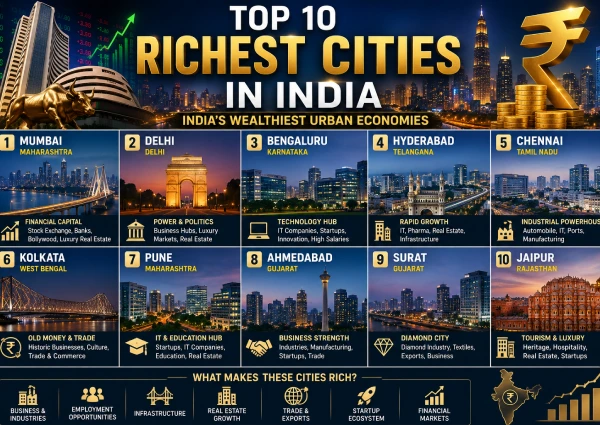
Top 10 Richest Cities in India Where Money, Business & Luxury Never Slow Down
When people talk about rich cities in India, most imagine skyscrapers, luxury cars, billion-dollar companies, expensive cafés, and crowded business districts.
And honestly, that image isn’t completely wrong.
Some Indian cities have grown so rapidly over the last two decades that they now feel like economic engines running nonstop day and night. Money moves fast there. Businesses expand quickly. Real estate prices keep climbing. And opportunities attract people from almost every corner of the country.
But what makes these cities interesting isn’t just wealth.
It’s the lifestyle, the energy, the ambition, and the way people live in these places.
Some cities became rich because of finance. Some because of technology. Others because of trade, startups, ports, manufacturing, or entertainment industries.
Here are the top 10 richest cities in India and what actually makes them so powerful economically.
1. Mumbai — The Financial Capital That Never Sleeps
Mumbai doesn’t feel slow even at 2 AM.
The city moves constantly. Local trains stay crowded, offices stay active late into the night, and business deals happen every single minute somewhere in the city.
It’s home to the Bombay Stock Exchange, major banks, corporate headquarters, Bollywood, luxury real estate, and some of India’s wealthiest families.
But Mumbai’s wealth is visible in strange ways.
One street may have billionaires living inside sea-facing towers while another nearby lane is packed with tiny roadside food stalls still working after midnight.
That contrast is part of Mumbai’s identity.
The city is expensive, exhausting, ambitious, and somehow addictive at the same time.
2. Delhi — Power, Politics & Massive Wealth
Delhi’s version of wealth feels different from Mumbai.
Mumbai feels corporate.
Delhi feels powerful.
Luxury cars, giant farmhouses, political influence, premium shopping areas, massive business markets — the city has money almost everywhere you look.
Areas like Connaught Place, South Delhi, and Gurugram’s nearby business hubs have turned the region into one of India’s largest economic zones.
But Delhi is also unpredictable.
One side of the city feels ultra-modern while another still feels deeply historical. That mix of old and new is what gives Delhi its unique personality.
And yes, people here absolutely love showing success openly.
3. Bengaluru — India’s Tech Money Machine
Bengaluru became rich differently from most Indian cities.
Technology changed everything.
Over the years, the city transformed into India’s startup and IT capital. Huge tech companies, software exports, startup founders, and high-paying corporate jobs completely reshaped the city’s economy.
Today, Bengaluru is filled with:
- Tech parks
- Startup offices
- Luxury apartments
- Expensive cafés
- Young professionals earning serious money
But despite all the growth, Bengaluru still somehow feels relaxed compared to Mumbai or Delhi.
Traffic may be terrible, but the city’s café culture, weather, and startup energy continue attracting people from across India.
4. Hyderabad — Fast Growth Without the Noise
Hyderabad has quietly become one of India’s strongest business cities.
And what’s interesting is that it happened without constantly demanding attention.
The city grew rapidly because of IT companies, pharma industries, real estate development, and infrastructure expansion. Areas like HITEC City completely changed Hyderabad’s image over the years.
Today, the city feels modern, clean, and financially strong.
But unlike Mumbai or Delhi, Hyderabad still feels slightly calmer and easier to live in.
That balance is one reason so many professionals now prefer it.
5. Chennai — The Industrial Giant
Chennai doesn’t always appear in flashy “luxury city” conversations.
But economically, it’s incredibly important.
The city is a major center for:
- Automobile manufacturing
- IT services
- Ports and trade
- Healthcare industries
- Electronics production
A lot of money flows through Chennai quietly through industries rather than visible luxury.
And honestly, that’s what makes the city different.
It feels practical, business-focused, and deeply hardworking.
6. Kolkata — Old Money, Old Business & Culture
Kolkata has a completely different relationship with wealth compared to modern corporate cities.
The city carries “old money” energy.
Historic business families, traditional markets, colonial architecture, and decades-old trading industries still shape Kolkata’s economy even today.
The city may not grow as aggressively as Bengaluru or Hyderabad, but its cultural influence, trade history, and business roots remain extremely important.
And honestly, Kolkata still feels unlike any other city in India.
7. Pune — The City That Became Rich Very Quickly
A few years ago, Pune was mostly known as a student city.
Now it feels completely different.
IT companies, startups, luxury housing, educational institutions, and manufacturing industries rapidly transformed Pune into one of India’s wealthiest urban economies.
The city attracts young professionals because it offers:
- Better weather
- Strong job opportunities
- Modern lifestyle
- Slightly lower living costs than Mumbai
And because of that, Pune keeps growing fast.
8. Ahmedabad — Business Runs Through the City
Ahmedabad has always had a strong business mindset.
People here understand trade naturally. Textile industries, manufacturing, chemicals, pharmaceuticals, and startups all contribute heavily to the city’s economy.
Unlike cities driven mainly by corporate offices, Ahmedabad feels entrepreneurial.
Many successful family businesses and industrial groups started here.
And even today, the city continues expanding rapidly with new infrastructure and business investments.
9. Surat — The Diamond Money Hub
Surat’s economy surprises many people.
The city is heavily connected to the diamond industry, textile business, and export markets. Huge amounts of money move through Surat every day because of these industries.
And despite becoming wealthier, Surat still feels simpler and more grounded compared to metro cities.
That’s part of its charm.
The city works hard, grows quietly, and keeps building wealth steadily.
10. Jaipur — Tourism, Luxury & Growing Business
Jaipur’s economy blends tourism, heritage, hospitality, and modern business growth together.
Luxury hotels, destination weddings, handicrafts, gemstone businesses, and tourism bring massive revenue into the city every year.
At the same time, Jaipur is also expanding in areas like:
- Startups
- Real estate
- Education
- IT services
The city still feels traditional, but economically it’s moving forward quickly.
What Actually Makes a City Rich?
People usually think rich cities are only about luxury lifestyles.
But real economic strength usually comes from:
- Business activity
- Industries
- Employment opportunities
- Real estate growth
- Infrastructure
- Trade and exports
- Corporate investments
Some cities become rich because of finance.
Others because of technology or manufacturing.
Every city has its own reason.
Final Thoughts
India’s richest cities are not all the same.
Mumbai feels fast and financially aggressive.
Bengaluru feels young and tech-driven.
Kolkata feels historical and cultural.
Hyderabad feels modern but balanced.
That’s what makes India interesting.
Every wealthy city built its success differently, and every one of them has a completely different personality once you actually experience it in real life.